
From Ancient Granite to a Georgia Landmark
Discover the fascinating history, natural beauty, historic attractions, and complicated legacy of one of Georgia's most recognizable destinations.
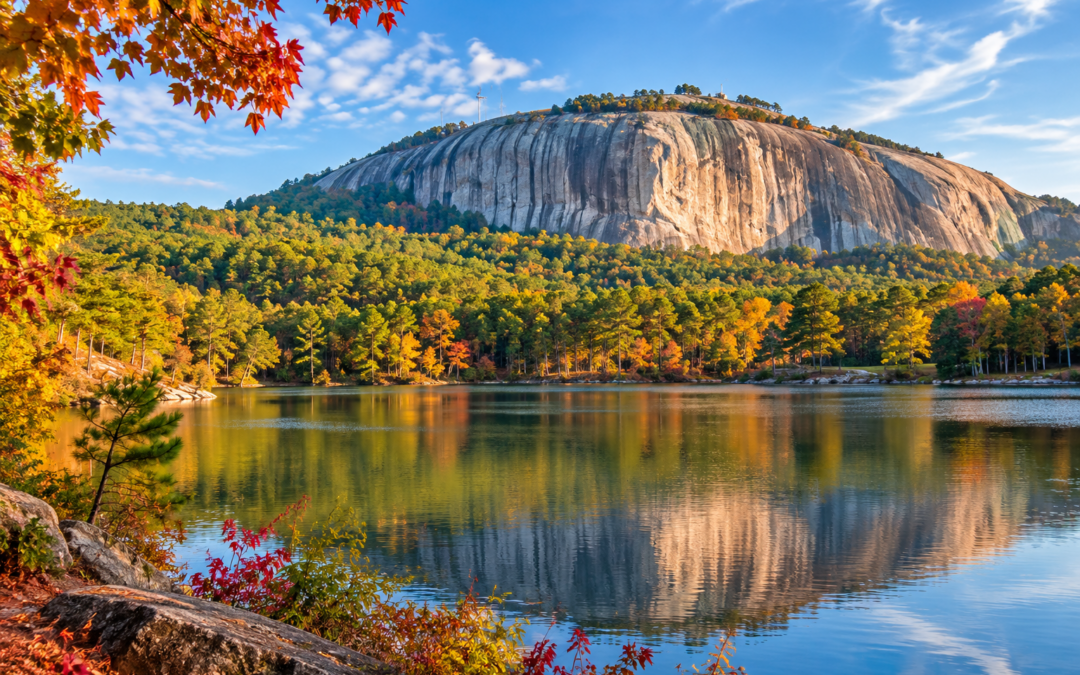
Located just east of Atlanta, Stone Mountain Park is one of Georgia's best-known landmarks. With its enormous granite mountain, scenic lakes, historic buildings, and family attractions, the park has welcomed generations of visitors.
But Stone Mountain's history stretches far beyond its development as a tourist destination. From its ancient geological beginnings and Native American heritage to its role in Georgia's railroad industry, the Civil War era, and the Civil Rights Movement, Stone Mountain tells a story that spans millions of years.
Today, the park represents both Georgia's natural beauty and an important, sometimes controversial, chapter of American history.
A Mountain Millions of Years in the Making
Long before Georgia became a state, Stone Mountain was forming deep beneath the Earth's surface.
Approximately 300 million years ago, molten rock slowly cooled underground, forming the massive body of stone that would eventually become Stone Mountain. Over millions of years, erosion removed the softer surrounding rock, exposing the enormous formation visible today.
Although commonly described as a granite mountain, its rock is more specifically classified as quartz monzonite.
Rising approximately 825 feet above the surrounding landscape and reaching an elevation of about 1,686 feet above sea level, Stone Mountain is an impressive natural landmark.
The mountain is often called the world's largest exposed piece of granite, although that familiar description oversimplifies its geology.
Its exposed rock surfaces, unusual plant communities, and panoramic views have attracted visitors for centuries.
Native American History and Early Settlement
Long before European settlers arrived, Native American peoples inhabited the region surrounding Stone Mountain.
Archaeological evidence indicates that Indigenous communities used the area for thousands of years. The mountain served as a recognizable landmark, and nearby forests and waterways provided valuable resources.
The region later became part of the homelands of the Muscogee (Creek) people.
During the early nineteenth century, Georgia's expansion and federal policies led to the dispossession and forced removal of Native American communities from much of the Southeast.
Following these changes, European American settlement increased around Stone Mountain.
As farms, roads, and small communities developed, the mountain became an increasingly important landmark for travelers and residents.
Stone Mountain and the Railroad Era
During the nineteenth century, Stone Mountain played an important role in Georgia's growth.
The arrival of the railroad helped transform the surrounding community into a center for commerce and industry.
Stone Mountain's extensive stone deposits became particularly valuable. Quarrying operations supplied building materials for construction projects throughout Georgia and beyond.
Workers cut enormous blocks of stone from the mountain, transporting them by rail for use in buildings, bridges, monuments, and other structures.
The granite industry provided employment and helped establish the town of Stone Mountain as a growing community.
By the late nineteenth century, the mountain was also becoming a popular destination for visitors interested in its unusual landscape and sweeping views.
The Confederate Memorial Carving
One of Stone Mountain's most recognizable features is the enormous carving on its northern face.
The sculpture depicts three Confederate leaders from the American Civil War: President Jefferson Davis, General Robert E. Lee, and General Thomas "Stonewall" Jackson, all shown on horseback.
The memorial project originated in the early twentieth century, decades after the Civil War ended.
Sculptor Gutzon Borglum, who later became famous for his work on Mount Rushmore, was selected to begin the project. Work began in the 1910s, with significant carving undertaken during the 1920s.
After disagreements and financial difficulties, Borglum left the project in 1925. Sculptor Augustus Lukeman subsequently developed a different design, but construction stopped in 1928 because of funding problems.
The project remained unfinished for decades.
In 1958, Georgia purchased Stone Mountain and surrounding property, establishing the Stone Mountain Memorial Association to oversee development of a public park and completion of the memorial.
Work resumed in 1964 under sculptor Walker Hancock, with Roy Faulkner serving as chief carver.
The memorial was dedicated on May 9, 1970, and completed in 1972.
Measuring approximately 90 feet high and 190 feet wide, the sculpture is considered the world's largest bas-relief carving. Stone Mountain Memorial Association+1
Stone Mountain's Connection to the Civil Rights Era
The mountain's history also includes a difficult chapter involving racial segregation and white supremacy.
In 1915, Stone Mountain was the site of a gathering associated with the revival of the Ku Klux Klan. The mountain subsequently became an important symbolic location for the organization.
The renewed push to complete the Confederate memorial during the 1950s occurred amid resistance to school desegregation and the growing Civil Rights Movement.
Georgia's purchase of Stone Mountain in 1958 followed the United States Supreme Court's landmark 1954 decision in Brown v. Board of Education, which declared racial segregation in public schools unconstitutional.
For these reasons, the Confederate carving remains controversial.
Some people regard it as a memorial connected to Southern ancestry and Civil War history. Others view it as a monument to the Confederacy, slavery, and the segregationist movements that shaped its development.
Understanding Stone Mountain's history requires acknowledging these perspectives while recognizing the documented connections between the memorial, white supremacy, and resistance to racial equality. New Georgia Encyclopedia+2
The Birth of Stone Mountain Park
Although the mountain had attracted visitors for generations, the modern Stone Mountain Park began taking shape following Georgia's purchase of the property in 1958.
During the early 1960s, roads, recreational facilities, and tourist attractions were developed around the mountain.
The Stone Mountain Scenic Railroad opened in 1962, offering visitors a relaxing journey through the surrounding landscape.
That same year, the Summit Skyride began operating, allowing guests to travel toward the mountain's summit without making the steep climb.
Stone Mountain Park officially opened on April 14, 1965.
Over the following years, additional attractions, picnic areas, golf facilities, and recreational opportunities helped establish the park as a major Georgia destination. ajc+1
Historic Buildings and Southern Traditions
Stone Mountain Park became known for preserving and displaying historic buildings associated with Georgia's past.
The Historic Square, formerly called the Antebellum Plantation, features historic structures brought to the park from locations throughout Georgia.
These buildings provide opportunities to explore nineteenth-century architecture and learn about the lives of people who lived and worked in the region, including enslaved African Americans.
Another notable landmark is the Washington W. King Bridge.
Originally constructed in Athens, Georgia, in 1891, the covered bridge was relocated to Stone Mountain Park in 1965.
The bridge was named in honor of Washington W. King, an African American bridge builder whose family contributed significantly to Georgia's construction history.
Today, it remains one of the park's picturesque historic features. Stone Mountain Park+1
The Famous Laser Show and Growing Popularity
In 1983, Stone Mountain Park introduced its famous laser show, which became one of its signature attractions.
Projected against the mountain's massive granite surface, the show combined colorful images, music, and special effects.
For many Georgia families, attending a summertime laser show became a cherished tradition.
The park continued expanding its recreational offerings, eventually adding seasonal festivals, children's activities, outdoor adventures, and holiday celebrations.
Stone Mountain also played a role in the 1996 Summer Olympic Games in Atlanta, hosting events involving archery, cycling, and tennis.
These events introduced the park to an international audience and reinforced its reputation as a major recreational destination. Stone Mountain Memorial Association
Stone Mountain Park Today
Today, Stone Mountain Park covers approximately 3,200 acres and continues to offer a variety of outdoor recreational opportunities.
Visitors can enjoy walking trails, lakeside scenery, wooded picnic areas, historic attractions, and breathtaking views from the mountain's summit.
The popular Walk-Up Trail allows hikers to climb the exposed stone surface and enjoy views of the surrounding Atlanta metropolitan area.
On clear days, the summit provides an extraordinary perspective of Georgia's Piedmont landscape.
Families also visit for seasonal events, recreational activities, and opportunities to experience the mountain's natural environment.
Alongside these attractions, discussions continue about how the park should interpret its Confederate memorial and present a fuller account of Georgia's history.
Preserving the Past for Future Generations
Stone Mountain Park is more than a tourist attraction. It is a place where geology, Indigenous history, industry, recreation, and America's complicated historical legacy come together.
Its granite slopes remind visitors of the extraordinary natural forces that shaped Georgia millions of years ago.
Its historic structures and railroad traditions recall the development of communities throughout the state.
And its Confederate memorial provides an opportunity to examine how history has been remembered, interpreted, and debated across generations.
Whether visiting to hike the mountain, explore historic sites, or simply enjoy a beautiful Georgia landscape, Stone Mountain offers an opportunity to experience a place that has played a distinctive role in the state's story.
From its ancient beginnings to its place in modern Georgia, Stone Mountain remains one of the state's most recognizable and historically significant landmarks.
*** Don't forget you can always find Creative Printing & Signs on social media as well. Here are our pages: Facebook, Instagram, Pinterest, and LinkedIn. You can also get all our past news by clicking here.
- Business Cards
- Banners
- Yard Signs
- Vehicle Graphics & Wraps
- Window Graphics
- Storefront Lettering
- Posters
- Brochures
- Door Hangers
- Custom Stickers & Labels
- Aluminum & Coroplast Signs
- Promotional Products
- Apparel Printing
- Restaurant Menus
- Coil-Bound Booklets
- And much more