
From Hidden Stills to Stock Car Racing
Tucked into the foothills of the North Georgia mountains, Dawson County is known today for beautiful scenery, outdoor recreation, and the city of Dawsonville’s remarkable connection to NASCAR. But long before stock cars roared around famous racetracks, another kind of high-speed driving was taking place on the winding mountain roads of Dawson County.
For decades, Dawson County was one of Georgia’s best-known centers for moonshine—the illegal production and transportation of untaxed whiskey. Hidden stills, mountain streams, cornfields, fast automobiles, and daring whiskey runners became part of a local culture that ultimately helped shape the history of American stock car racing.
Moonshine in the North Georgia Mountains
Distilling whiskey in the Appalachian region dates back generations. For rural farming families, whiskey could be an economical way to turn corn and other crops into a product that was easier to transport and sell.
Dawson County was particularly suited to the practice. Much of the county was rural and mountainous, with wooded hollows and streams providing secluded locations and plentiful water for still operations.
Farming remained an important part of Dawson County’s economy for much of its early history. When opportunities to earn cash were limited, producing whiskey could provide an additional source of income.
Moonshine production was illegal when distillers avoided federal taxes or operated without required licenses, and the long-running battle between mountain distillers and federal revenue officers became part of Appalachian history.
Then came Prohibition.
Prohibition Turns Moonshine Into Big Business
Georgia enacted statewide prohibition in 1907, years before national Prohibition began in 1920. Instead of eliminating the demand for alcohol, prohibition created an enormous illegal market.
Dawsonville became so closely associated with illegal liquor production that it earned a reputation as Georgia’s “Moonshine Capital.”
According to historical information from the City of Dawsonville, many local families participated in some part of the moonshine economy during Prohibition. The business involved much more than simply operating a still.
Farmers grew corn and sugar cane. Others supplied containers. Still operators produced the whiskey. Mechanics modified automobiles, and drivers transported the finished product to customers.
Dawsonville’s historical documents refer to this interconnected system as the “Moonshine Chain.”
The trade also continued long after national Prohibition ended in 1933. Large-scale moonshine production around Dawsonville reportedly continued well into the 1970s.
Millions of Gallons Headed Toward Atlanta
Atlanta provided moonshiners with something extremely important: a large market.
The New Georgia Encyclopedia reports that Dawson County moonshiners transported millions of gallons of whiskey toward Atlanta. Nearby mountain counties, including Lumpkin, Gilmer, and Pickens, also became significant moonshine-producing areas during the 1930s and 1940s.
Getting the whiskey from a hidden mountain still to its customers was risky.
Federal revenue officers—often called “revenuers”—worked to locate illegal stills and intercept whiskey shipments. Moonshiners responded with secrecy, ingenuity, and increasingly powerful automobiles.
This struggle produced one of the most colorful characters in Dawson County history: the whiskey runner.
Dawson County’s Legendary “Trippers”
The men who transported moonshine were frequently called “trippers.”
Their job required more than simply driving from one location to another. A car loaded with jars or containers of whiskey could be extremely heavy, yet the driver still needed enough speed to escape law enforcement.
Cars were modified accordingly.
Engines were improved for greater horsepower. Suspensions could be strengthened to carry heavy loads. The cars needed to remain stable on twisting roads while still appearing ordinary enough not to immediately attract attention.
Historical accounts describe high-performance vehicles known as “tanker cars,” with 1940-era Fords becoming particularly associated with the trade.
A talented tripper needed an intimate knowledge of North Georgia’s roads. He needed to understand every curve, hill, bridge, and possible escape route—and he needed nerves strong enough to drive those roads at high speed, sometimes at night.
Running Moonshine Down Highway 9
One road became especially connected with Dawsonville’s moonshine legend: Georgia Highway 9.
Highway 9 runs through Dawsonville and south toward the Atlanta area. Before the number became famous through Dawsonville’s later racing history, the highway was associated with whiskey runners transporting illegal liquor out of the North Georgia mountains.
NASCAR has described Highway 9 as a lifeline for Dawsonville whiskey trippers carrying their products toward Atlanta.
Imagine the scene decades ago: a powerful Ford traveling through the darkness, its suspension carrying a heavy load of illegal whiskey while the driver navigated the curves of a mountain highway.
Those drivers became extremely skilled behind the wheel.
Eventually, some began asking a simple question:
Who had the fastest car?
From Whiskey Running to Stock Car Racing
That question helped create a connection between Dawson County moonshine and the emerging sport of stock car racing.
Moonshine runners already possessed many of the ingredients necessary for racing. They had powerful modified automobiles, talented mechanics, skilled drivers, and a competitive desire to prove who was fastest.
Informal races gave drivers an opportunity to test their automobiles—and their abilities—against one another.
Dawsonville eventually became recognized as an important location in the early history of Southern stock car racing. The New Georgia Encyclopedia notes that many observers consider Dawsonville one of NASCAR’s birthplaces. Several influential early racing figures came from Dawson County.
Among the most important was Raymond Parks.
Born in Dawson County in 1914, Parks became involved in the liquor business before becoming one of stock car racing’s pioneering team owners. NASCAR records that Parks began fielding race cars in 1938 with drivers Lloyd Seay and Roy Hall.
Seay and Hall were Parks’ cousins and had connections to moonshine running.
Parks would eventually become one of the most significant owners in NASCAR’s earliest years. His driver Red Byron won NASCAR’s Modified championship in 1948 and the first championship of NASCAR’s top stock-car division in 1949. Parks was inducted into the NASCAR Hall of Fame in 2017.
The Dawsonville Gang
Dawsonville produced an extraordinary number of talented racers for such a small community.
Names such as Lloyd Seay, Roy Hall, Gober Sosebee, Bernard Long, and Raymond Parks became associated with the early days of stock car racing.
Dawsonville drivers enjoyed remarkable success on Daytona’s old beach-and-road course. NASCAR records show that Dawsonville racers including Sosebee, Hall, Seay, and Long won races there between 1941 and 1959.
The tradition did not end with NASCAR’s pioneers.
Decades later, Dawsonville became nationally famous again through Bill Elliott, the 1988 NASCAR Cup Series champion and winner of the 1985 and 1987 Daytona 500s.
A new generation followed when Bill’s son Chase Elliott became a NASCAR champion himself.
That means Dawsonville’s relationship with fast automobiles stretches from whiskey runners on mountain roads to some of the biggest stages in American motorsports.
Preserving Dawson County’s Moonshine Heritage
Today, moonshine is no longer something Dawsonville discusses only in whispers.
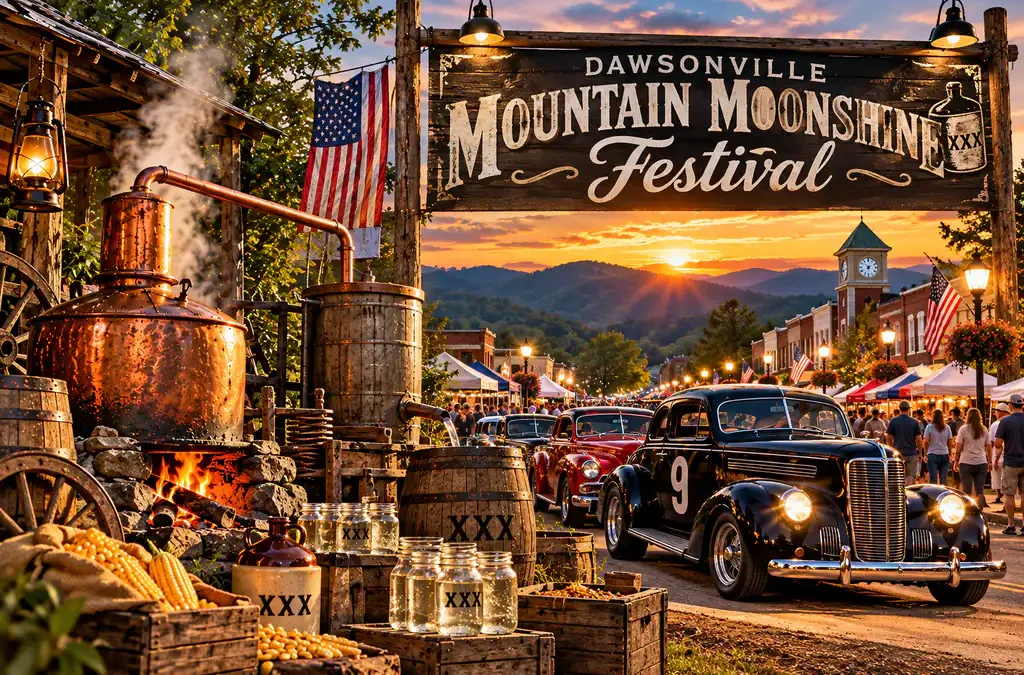
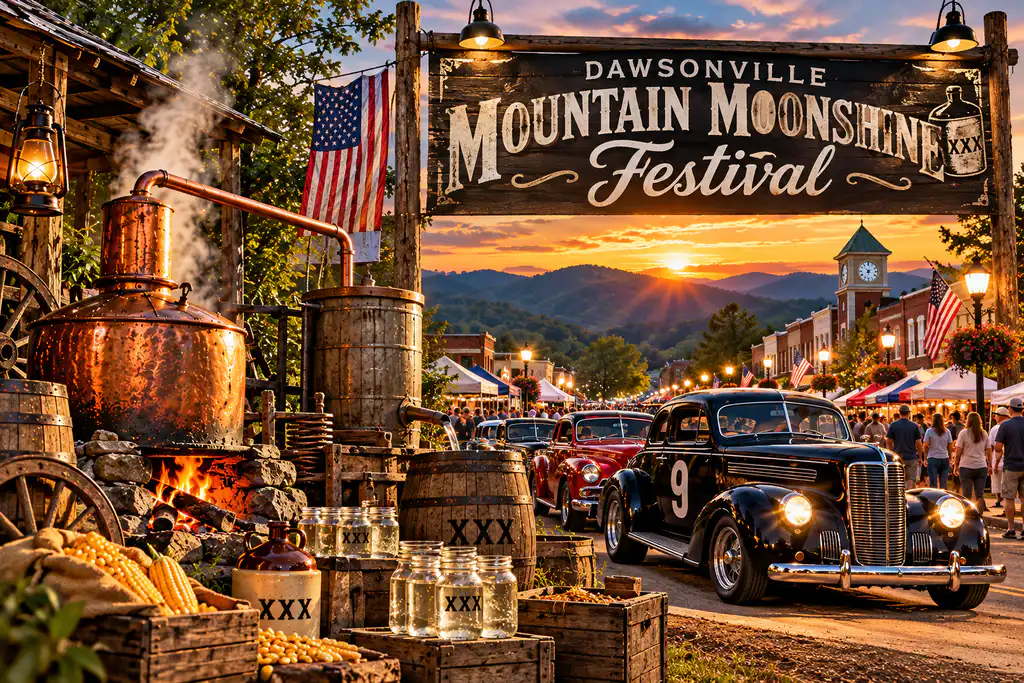
The community openly recognizes the role that moonshine played in its history. Dawsonville’s annual Mountain Moonshine Festival has celebrated the region’s heritage for decades, bringing together historic automobiles, local traditions, and stories from the area’s past. City records show that the festival was already celebrating its 53rd year in 2020.
The connection between moonshine and racing remains one of Dawson County’s most distinctive historical stories.
It is important, however, to remember that moonshining was not simply a romantic adventure involving fast cars and hidden stills. It was an illegal and sometimes dangerous business. Conflicts with law enforcement, accidents, and disputes occasionally had deadly consequences.
For many rural families, though, moonshine was also tied to economics and survival during periods when opportunities in the North Georgia mountains were limited.
A Uniquely Dawson County Story
Dawson County’s moonshine history is ultimately about much more than illegal whiskey.
It tells the story of mountain farmers, craftsmen, mechanics, drivers, and families adapting to difficult economic circumstances. It demonstrates how isolation, geography, agriculture, prohibition laws, and the growing market in Atlanta combined to create an underground industry.
And it produced an unexpected legacy.
Moonshiners needed faster automobiles to transport their whiskey. Mechanics learned to make those cars stronger and more powerful. Drivers learned to control them on narrow, twisting mountain roads. Those drivers eventually raced one another—and some became pioneers of organized stock car racing.
That is why Dawsonville’s moonshine and racing histories are almost impossible to separate.
From copper stills hidden beside cold mountain streams to whiskey cars racing down Highway 9 and eventually to stock cars speeding around Daytona, Dawson County helped write a fascinating chapter in both Georgia and American history.
The stills may have disappeared from many of the hidden mountain hollows, but the legacy of Dawson County’s moonshine days continues to live on every time Dawsonville celebrates its history—and every time one of its famous racers takes the green flag.
*** Don't forget you can always find Creative Printing & Signs on social media as well. Here are our pages: Facebook, Instagram, Pinterest, and LinkedIn. You can also get all our past news by clicking here.
- Business Cards
- Banners
- Yard Signs
- Vehicle Graphics & Wraps
- Window Graphics
- Storefront Lettering
- Posters
- Brochures
- Door Hangers
- Custom Stickers & Labels
- Aluminum & Coroplast Signs
- Promotional Products
- Apparel Printing
- Restaurant Menus
- Coil-Bound Booklets
- And much more