
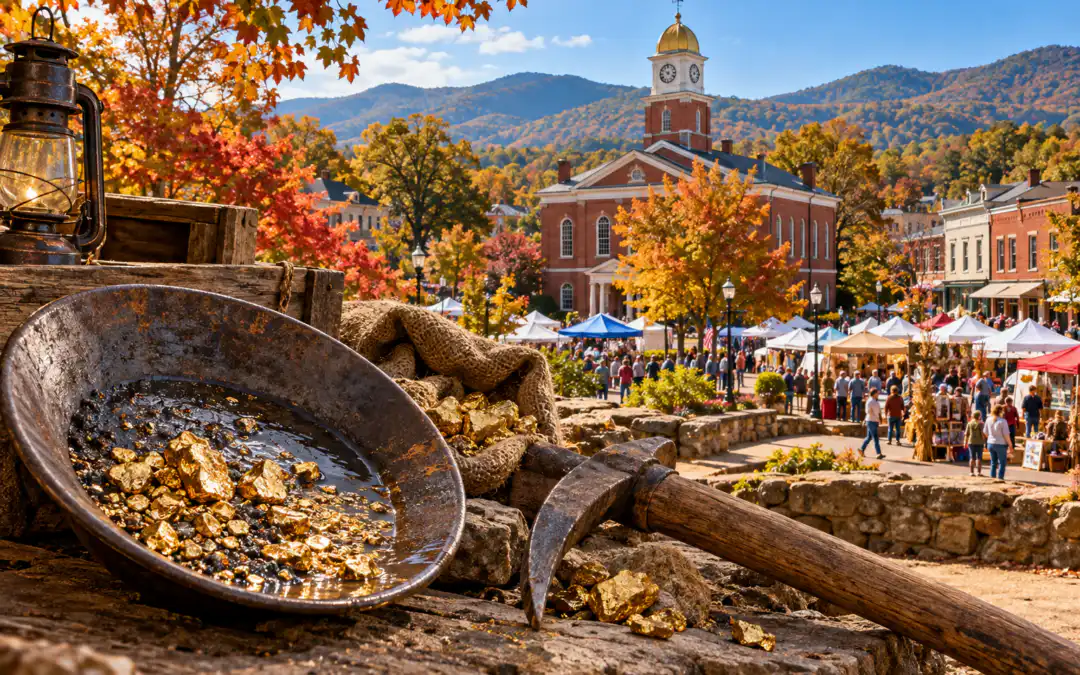
From the Discovery of Gold in 1828 to Today's Gold Rush Days Festival
How a discovery in the North Georgia mountains changed American history and created a tradition that continues nearly 200 years later.
Long before California became famous for its Gold Rush of 1849, another gold rush was already transforming the mountains of North Georgia. In 1828, the discovery of gold in what is now Lumpkin County brought thousands of prospectors, merchants, and settlers to the area. This remarkable chapter in American history helped establish Dahlonega, Georgia, as one of the nation's most historically significant gold-mining towns.
Nearly two centuries later, Dahlonega continues to celebrate its golden heritage through the annual Gold Rush Days Festival, an event that attracts visitors from across Georgia and beyond.
The Discovery That Started It All
The story of Dahlonega's Gold Rush begins in 1828, when gold was discovered in the foothills of the Blue Ridge Mountains.
According to a popular local legend, a deer hunter named Benjamin Parks stumbled upon a gold-bearing rock while walking through the woods near present-day Dahlonega. Although historians continue to debate the precise circumstances of the first discovery, there is no question that gold was found in significant quantities throughout the region.
Word of the discovery spread rapidly. Prospectors arrived carrying picks, shovels, pans, and dreams of striking it rich.
By the early 1830s, thousands of miners were searching the creeks, streams, and hillsides of North Georgia. Some discovered valuable deposits, while others spent years working difficult claims with little reward.
The Georgia Gold Rush had officially begun, approximately twenty years before the better-known California Gold Rush.
The Birth of Dahlonega and Auraria
As prospectors flooded into the region, mining settlements quickly developed.
One of the earliest communities was Auraria, located southwest of present-day Dahlonega. Its name came from the Latin word for gold, reflecting the precious metal that brought settlers into the mountains.
In 1832, Lumpkin County was established, and Auraria initially served as its county seat. However, in 1833, a new community was selected as the permanent county seat.
That community became Dahlonega.
The name Dahlonega is generally traced to a Cherokee word associated with yellow or gold, a fitting name for a town built around the mining industry.
By 1836, a courthouse stood in the center of the town square. That historic building survives today as the Dahlonega Gold Museum, serving as a reminder of the town's extraordinary beginnings.
The Cherokee Nation and the Gold Rush
The Gold Rush also had devastating consequences for the Cherokee people, who had occupied the region long before prospectors arrived.
Gold discoveries increased pressure on Cherokee lands as miners entered the territory despite objections from Cherokee leaders.
In 1832, Georgia distributed seized Cherokee lands through a land lottery. During the following years, federal and state policies contributed to the forced removal of the Cherokee people.
In 1838, thousands were forced westward in what became known as the Trail of Tears. Many died during the journey.
This painful history remains an essential part of understanding Dahlonega's Gold Rush. The wealth and development associated with gold mining came at a tremendous human cost to the Cherokee Nation.
The Dahlonega Mint: Turning Georgia Gold Into American Coins
As mining expanded, the federal government recognized the importance of North Georgia's gold deposits.
In 1838, the United States established a branch mint in Dahlonega. The facility produced gold coins, including $2.50 quarter eagles, $5 half eagles, $1 gold pieces, and limited numbers of $3 gold coins.
Between 1838 and 1861, the Dahlonega Mint produced more than $6 million in gold coinage, an impressive amount for the period.
The mint ceased operations during the Civil War and never reopened.
The original building later became part of North Georgia Agricultural College, the predecessor of today's University of North Georgia. After the building burned in 1878, Price Memorial Hall was constructed on the site.
Today, the gold-covered steeple of Price Memorial Hall remains one of Dahlonega's most recognizable landmarks, symbolizing the town's golden past.
When the Gold Rush Began to Fade
By the late 1840s, many of the easiest gold deposits had been exhausted.
Then came the discovery of gold in California in 1848. News of greater opportunities in the West attracted many miners who had previously worked the Georgia goldfields.
Although mining continued in Lumpkin County, the original rush gradually diminished.
Mining operations later expanded through more advanced methods, including underground mining and the use of large machinery.
One of the most famous operations was the Consolidated Gold Mine, developed in the late nineteenth century. Today, visitors can tour underground mining tunnels and learn about the challenging conditions faced by miners.
Crisson Gold Mine also preserves the area's mining traditions, offering opportunities to experience gold panning.
These attractions help keep Dahlonega's mining history alive for new generations.
The Beginning of Gold Rush Days
Although commercial gold mining declined, Dahlonega never forgot the discovery that shaped its identity.
More than seventy years ago, the community established a celebration honoring its gold-mining heritage.
That celebration grew into the Gold Rush Days Festival, now one of North Georgia's most popular annual fall events.
Held each October, the festival brings together local residents, artists, craftspeople, musicians, and visitors for a weekend celebrating the town's history and Appalachian traditions.
The historic public square becomes the center of the festivities, surrounded by the same mountain scenery that once attracted thousands of hopeful prospectors.
What began as a celebration of local history has become an important tradition for Dahlonega and Lumpkin County.
Gold Rush Days Festival 2026: A Tradition Continues
October 17–18, 2026
Historic Downtown Dahlonega, Georgia
This year's Gold Rush Days Festival will take place Saturday, October 17, and Sunday, October 18, 2026.
The 72nd annual celebration promises another exciting weekend in the heart of downtown Dahlonega.
Visitors can enjoy more than 300 arts, crafts, and food exhibitors throughout the historic district. Handmade jewelry, woodworking, artwork, seasonal decorations, and Appalachian crafts are among the attractions.
Live music, traditional demonstrations, children's activities, and opportunities to learn about gold panning make the festival entertaining for visitors of all ages.
One of the most anticipated events is the Gold Rush Days Parade, scheduled for Saturday, October 17, at 3:00 p.m.
The festival also offers an opportunity to explore Dahlonega's locally owned shops, restaurants, historic buildings, and surrounding mountain scenery.
For additional information and updated schedules, visit the official Gold Rush Days Festival website.
More Than a Festival: Supporting the Community
Gold Rush Days is more than an annual celebration. It also provides meaningful support to the local community.
The festival is organized with volunteer involvement, and its proceeds help support scholarships, charitable projects, local nonprofit organizations, and families in need.
Among its community programs is the Empty Stocking Fund, which helps provide necessities and Christmas gifts for families during the holiday season.
Scholarship programs also benefit graduating students from Lumpkin County High School and Mountain Education Charter High School.
These efforts demonstrate how a festival celebrating Dahlonega's past continues to make a positive difference in its present.
Preserving Dahlonega's Golden Heritage
Today, Dahlonega's greatest treasure may not be the gold hidden beneath its mountains, but the history, traditions, and community spirit that remain.
Visitors can explore the Dahlonega Gold Museum, tour historic mines, stroll around the downtown square, and admire the gold-covered steeple of Price Memorial Hall.
Every October, Gold Rush Days brings these stories together in a celebration that connects the town's remarkable past with its thriving present.
From the first gold discoveries of 1828 to the bustling festival of 2026, Dahlonega remains a place where history truly shines.
Nearly 200 years after the first prospectors arrived, the golden spirit of Dahlonega is still alive.
*** Don't forget you can always find Creative Printing & Signs on social media as well. Here are our pages: Facebook, Instagram, Pinterest, and LinkedIn. You can also get all our past news by clicking here.
- Business Cards
- Banners
- Yard Signs
- Vehicle Graphics & Wraps
- Window Graphics
- Storefront Lettering
- Posters
- Brochures
- Door Hangers
- Custom Stickers & Labels
- Aluminum & Coroplast Signs
- Promotional Products
- Apparel Printing
- Restaurant Menus
- Coil-Bound Booklets
- And much more