Signs are everywhere: Get to know the Sign Business.
From Hand-Painted Signs to Digital Printing
Signs are everywhere. They identify businesses, point us in the right direction, advertise products, announce events, and help companies build recognizable brands. From a simple yard sign to a large illuminated storefront sign, signage remains one of the most effective ways for a business or organization to communicate with the public.
The sign business, however, did not begin with computers, vinyl cutters, or wide-format printers. Its history stretches back thousands of years and reflects the development of commerce, transportation, advertising, art, and technology.
Signs in the Ancient World
Some of the earliest signs were created because merchants needed a way to identify what they sold. Long before widespread literacy, pictures and symbols were especially useful. A merchant could display an image representing bread, wine, shoes, or another product, allowing customers to understand the purpose of the establishment without reading a written description.
The Greeks and Romans also used signs to identify businesses and public establishments. Signs could be painted, carved into stone, or fashioned from other durable materials.
This established one of the basic principles of signage that remains important today: a good sign needs to communicate its message quickly and clearly.
The Rise of the Traditional Sign Painter
As towns and commercial districts expanded, signs became increasingly important to businesses. Taverns, inns, blacksmith shops, general stores, and other establishments displayed signs to attract customers and distinguish themselves from their competitors.
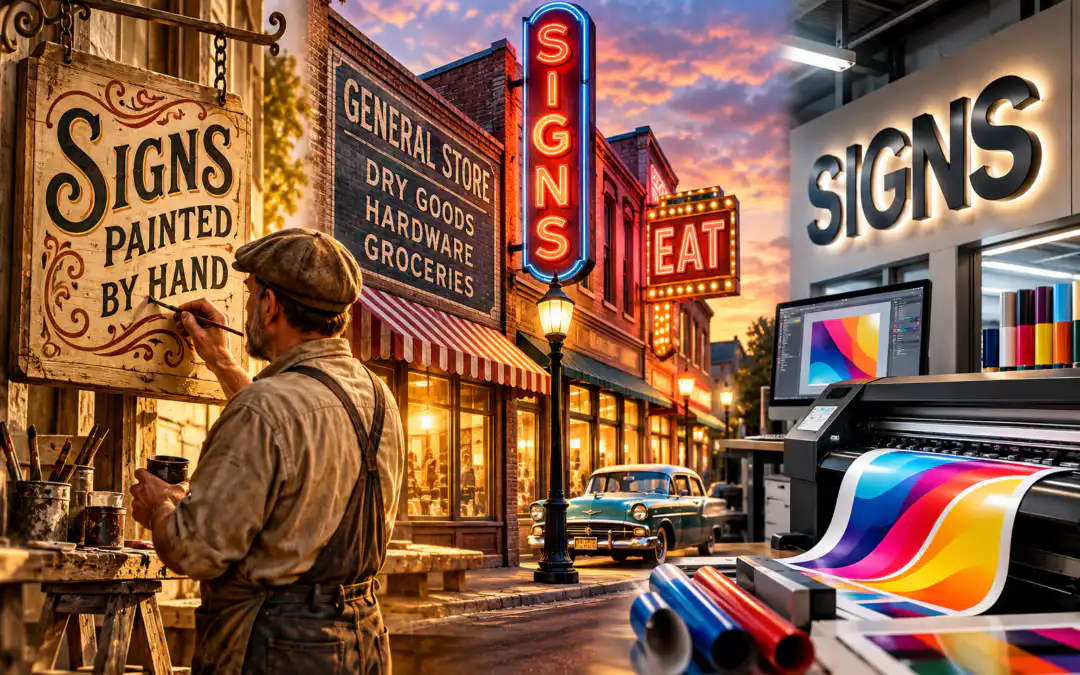
For generations, making signs was primarily a handcraft.
Professional sign painters became highly skilled at creating letters with brushes and paint. A talented sign painter needed a steady hand, a strong understanding of typography, and the ability to lay out words so they could be easily read from a distance.
Many sign painters also specialized in decorative borders, illustrations, gold leaf, dimensional lettering, and painted advertisements.
By the late 1800s and early 1900s, hand-painted advertising could be found on storefronts, windows, barns, vehicles, and the brick walls of buildings throughout America. Faded examples of these old advertisements—sometimes called “ghost signs”—can still be seen on historic buildings today.
Electric Signs Change the Landscape
Electricity transformed the sign industry.
Businesses were no longer limited to signs that could only be easily seen during daylight hours. Electric bulbs made it possible for storefronts, theaters, restaurants, and hotels to advertise after dark.
Then came one of the most recognizable developments in sign history: neon.
Neon advertising signs became commercially important during the early decades of the twentieth century. By the 1920s and 1930s, colorful illuminated signs were changing the appearance of commercial districts.
Neon eventually became closely associated with theaters, motels, diners, casinos, restaurants, and roadside businesses. Elaborate neon signs turned advertising into an attraction of its own.
Signs and the Automobile
The rapid growth of automobile travel created another major opportunity for the sign industry.
Businesses suddenly needed signs that motorists could recognize and read while traveling at much greater speeds than pedestrians. Letters became larger, messages became shorter, and signs were positioned for visibility from the road.
Roadside restaurants, gas stations, hotels, tourist attractions, and retailers increasingly relied on large signs to attract passing motorists.
Billboards also became an increasingly important advertising medium.
The automobile therefore influenced not only where signs were placed but also how they were designed—a principle sign professionals still consider when determining letter size, contrast, placement, and viewing distance.
Vinyl Revolutionizes Sign Making
For much of the twentieth century, hand lettering remained an important sign-making skill. Eventually, however, new materials and equipment dramatically changed production.
One of the biggest changes was the development of pressure-sensitive vinyl and computerized vinyl-cutting equipment.
Instead of painting every individual letter by hand, a sign maker could design lettering, send the design to a cutter, weed away the unwanted vinyl, and apply the finished graphics to a sign panel, window, or vehicle.
Vinyl opened the door to an enormous range of applications, including storefront lettering, banners, vehicle graphics, window graphics, decals, directional signs, and yard signs.
Traditional sign painting did not disappear, but computerized production allowed sign shops to produce many types of signage faster and with remarkable consistency.
The Digital Printing Revolution
The introduction of large-format digital printing brought another enormous transformation.
Modern wide-format printers can reproduce photographs, gradients, logos, detailed illustrations, and full-color designs on materials used for indoor and outdoor advertising.
A project that once required extensive hand painting can now begin with a digital design and be produced with exceptional detail and color.
Modern sign shops can produce banners, posters, decals, window graphics, vehicle graphics, wall graphics, and many other products using digital printing technology.
Computers have also changed the design process itself. Graphic design software allows sign professionals to create precise layouts, work with vector artwork, match colors, resize graphics, and prepare files for several different types of production equipment.
Signs in the Modern Business World
Today, the sign industry combines traditional craftsmanship with advanced technology.
A modern sign professional may work with vinyl cutters, wide-format printers, laminators, computers, specialty films, aluminum, acrylic, corrugated plastic, banner material, and numerous other substrates.
LED illumination has also changed the industry by providing businesses with bright, energy-efficient options for illuminated signs and dimensional lettering.
Yet despite all these technological advances, the basic purpose of a sign has changed very little.
A sign still has to get someone's attention and communicate a message.
From a Paintbrush to a Wide-Format Printer
Perhaps the most interesting part of the sign industry's history is how much the equipment has changed while the goal has remained the same.
Yesterday's sign maker might have stood on a ladder with a mahl stick, brush, and can of paint. Today's sign maker may sit at a computer designing vector artwork before sending the finished file to a wide-format printer or vinyl cutter.
Both are practicing versions of the same trade.
The tools have evolved from paintbrushes and hand-carved letters to computers, digital printers, vinyl cutters, and LED lighting, but successful sign making still requires creativity, craftsmanship, attention to detail, and an understanding of what makes a message visible.
A Trade That Continues to Evolve
The sign business has survived thousands of years because businesses will always need ways to identify themselves and communicate with customers.
Technology will continue to change. Printing equipment will become faster, materials will improve, and new forms of digital and illuminated signage will appear. But physical signs will continue to play an important role in communities and commerce.
From an ancient merchant's symbol to a hand-painted storefront, from a glowing neon sign to a digitally printed vehicle graphic, every generation has found new ways to accomplish the same goal:
Get noticed, communicate clearly, and make a lasting impression.
That is the history of the sign business—and it is a history that sign makers continue adding to every day.
*** Don't forget you can always find Creative Printing & Signs on social media as well. Here are our pages: Facebook, Instagram, Pinterest, and LinkedIn. You can also get all our past news by clicking here.
- Business Cards
- Banners
- Yard Signs
- Vehicle Graphics & Wraps
- Window Graphics
- Storefront Lettering
- Posters
- Brochures
- Door Hangers
- Custom Stickers & Labels
- Aluminum & Coroplast Signs
- Promotional Products
- Apparel Printing
- Restaurant Menus
- Coil-Bound Booklets
- And much more