
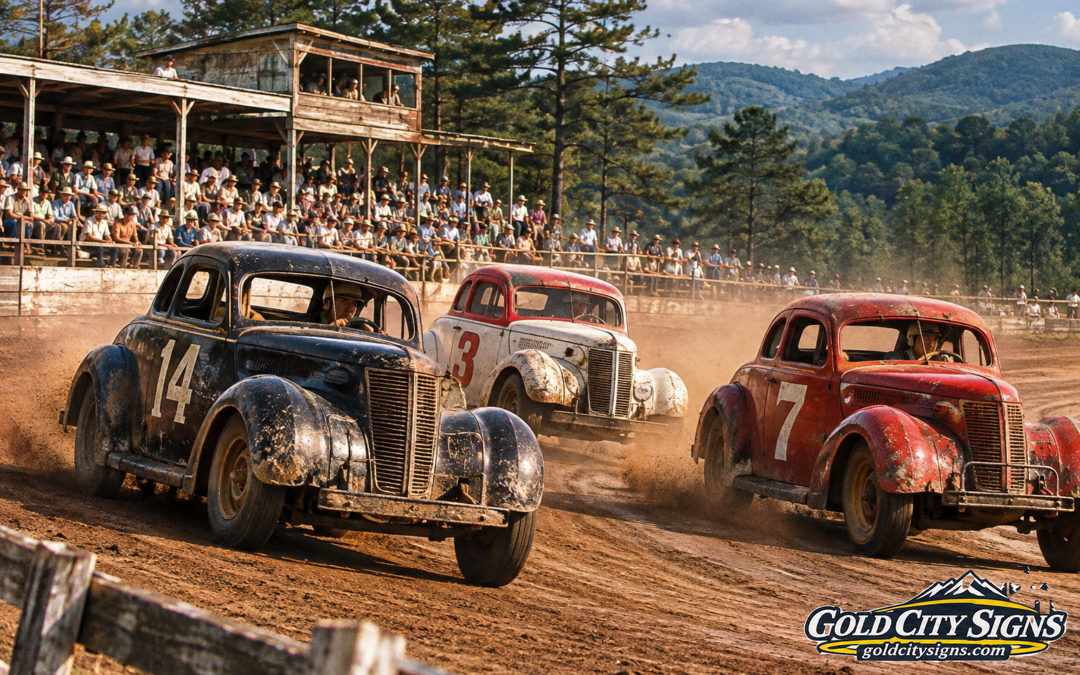
NASCAR's Roots / From Moonshine Runners to NASCAR Legends
How the winding mountain roads of North Georgia helped shape one of America's most popular motorsports.
Georgia has a special place in the history of American stock car racing. Long before NASCAR became a nationally recognized sport, daring drivers were racing powerful automobiles along the winding dirt roads of North Georgia. Many of these early drivers were moonshine runners who developed extraordinary driving skills while transporting illegal whiskey through the mountains.
From the backroads of Dawsonville to the famous dirt track at Lakewood Speedway and the high-speed competition at Atlanta Motor Speedway, Georgia helped shape the sport that millions of Americans enjoy today.
The history of stock car racing in Georgia is a fascinating story of courage, competition, mechanical ingenuity, and small-town traditions that grew into a national phenomenon.
The Moonshine Connection: Where Georgia Racing Began
During the 1920s and 1930s, North Georgia became well known for its moonshine production. The mountainous regions surrounding Dawsonville, Dahlonega, and other Appalachian communities provided secluded locations for illegal whiskey operations.
Transporting moonshine was dangerous business. Drivers had to navigate narrow, twisting mountain roads, often at night, while avoiding federal revenue agents and local law enforcement.
To improve their chances of escaping capture, moonshine runners modified ordinary passenger cars with more powerful engines, improved suspensions, and other mechanical upgrades. From the outside, many vehicles appeared relatively ordinary, but underneath their hoods were machines built for speed.
These drivers became experts at handling automobiles under difficult conditions. Their ability to maneuver through sharp curves, accelerate quickly, and maintain control on rough roads would eventually prove valuable on the racetrack.
Before organized stock car racing became popular, some moonshine drivers challenged one another to informal races to determine who had the fastest car and the greatest driving ability.
Dawsonville, Georgia, became particularly famous for these early competitions and is widely recognized as one of the birthplaces of stock car racing. New Georgia Encyclopedia+1
Dawsonville's Racing Pioneers
Several of stock car racing's earliest influential personalities came from Dawson County.
One of the most important was Raymond Parks, a Dawsonville native who became a successful businessman and racing team owner.
In the late 1930s, Parks began financing racing operations involving talented drivers, including his cousins Roy Hall and Lloyd Seay. Both men had experience driving fast automobiles on North Georgia's mountain roads.
Parks understood that successful racing required more than a talented driver. It also demanded well-prepared automobiles, knowledgeable mechanics, and financial backing.
His racing teams became some of the most competitive in the sport's early years.
Lloyd Seay was especially admired for his fearless driving ability. Although his life was tragically cut short in 1941, his accomplishments helped establish North Georgia's reputation for producing exceptional racing talent.
Roy Hall also became a prominent early competitor, earning recognition for his aggressive driving style and racing success.
These pioneers helped transform informal automotive competitions into an organized spectator sport. Georgia Racing Hall of Fame+1
Lakewood Speedway: Georgia's Early Racing Landmark
One of the most important locations in Georgia racing history was Lakewood Speedway, located south of downtown Atlanta.
The one-mile dirt track at the Lakewood Fairgrounds became a major destination for early stock car racing.
On November 11, 1938, Lakewood hosted a historic stock car race featuring drivers with backgrounds in moonshine transportation and other forms of automobile competition.
Lloyd Seay emerged victorious, helping establish the speedway as a significant racing venue.
The event took place a full decade before NASCAR's founding in 1948.
Throughout the 1940s and 1950s, Lakewood Speedway attracted enthusiastic crowds eager to watch drivers battle around its dusty oval.
Spectators witnessed automobiles sliding through turns, kicking up clouds of dirt, and racing at speeds that seemed extraordinary for the time.
Lakewood eventually hosted NASCAR's premier division, with Tim Flock winning its first NASCAR Grand National race in 1951.
For decades, the speedway remained an important part of Georgia's motorsports culture before stock car racing ended there in 1979. peachstatespeed.com+2
Georgia's Role in the Birth of NASCAR
The National Association for Stock Car Auto Racing, better known as NASCAR, was founded in 1948 under the leadership of Bill France Sr.
Although NASCAR was formally established in Florida, Georgia racing pioneers played an essential role in the sport's early success.
Raymond Parks became one of NASCAR's first major team owners. His organization employed skilled mechanics and competitive drivers who helped demonstrate the potential of professionally organized stock car racing.
In 1948, Red Byron won NASCAR's inaugural Modified Division championship driving for Parks. The following year, Byron captured the first championship in NASCAR's Strictly Stock Division, the predecessor of today's Cup Series.
Georgia's contributions extended beyond drivers and team owners. Mechanics, engine builders, promoters, and racetrack operators from the state helped develop the sport's early identity.
What began as competition among regional drivers was becoming a professionally organized racing industry. New Georgia Encyclopedia+1
Atlanta Motor Speedway: A New Era of Racing
As stock car racing gained popularity during the 1950s, larger and faster racing facilities became necessary.
In 1960, Atlanta Motor Speedway opened in Hampton, Georgia, approximately 25 miles south of Atlanta.
Originally known as Atlanta International Raceway, the 1.5-mile speedway represented a major step forward for Georgia motorsports.
On July 31, 1960, approximately 25,000 spectators attended the track's inaugural NASCAR race. Glenn "Fireball" Roberts won the event, beginning a tradition of major stock car racing competitions at the facility.
Over the following decades, Atlanta Motor Speedway hosted some of NASCAR's most memorable competitions and welcomed legendary drivers, including Richard Petty, David Pearson, Dale Earnhardt, and Bill Elliott.
The speedway became an important destination for racing fans throughout Georgia and the southeastern United States.
Its continued development helped establish Georgia as a major center for professional motorsports. Today In Georgia History+1
Bill Elliott: Awesome Bill from Dawsonville
No discussion of Georgia stock car racing would be complete without mentioning Bill Elliott.
Born in Dawsonville, Elliott became one of NASCAR's most beloved competitors.
Known affectionately as "Awesome Bill from Dawsonville," he achieved national recognition through his exceptional driving ability, remarkable speed, and numerous victories.
Elliott won the NASCAR Cup Series championship in 1988 and captured the prestigious Daytona 500 twice, in 1985 and 1987.
His success brought enormous pride to Dawsonville and the surrounding North Georgia communities.
Elliott's accomplishments also demonstrated how a driver from a small mountain town could compete successfully against the biggest names in American motorsports.
In 2015, he was inducted into the NASCAR Hall of Fame, cementing his place among the sport's greatest competitors. New Georgia Encyclopedia+1
Chase Elliott: Continuing the Family Tradition
The Elliott family's racing legacy continued through Bill Elliott's son, Chase Elliott.
Growing up in Dawsonville, Chase followed in his father's footsteps and developed into one of NASCAR's leading competitors.
In 2020, Chase won the NASCAR Cup Series championship, making Bill and Chase Elliott one of the few father-and-son combinations to capture championships at NASCAR's highest level.
Their achievements helped keep Dawsonville in the national spotlight and introduced a new generation of racing fans to Georgia's remarkable motorsports heritage.
Georgia's Forgotten Racetracks
Although Atlanta Motor Speedway receives much of the attention today, numerous other racetracks contributed to Georgia's stock car racing history.
During the 1950s and 1960s, NASCAR events were held at tracks throughout the state, including Augusta, Macon, Savannah, Columbus, and Jefferson.
Many of these facilities were modest dirt tracks where local mechanics, independent drivers, and racing enthusiasts gathered for exciting weekend competitions.
These smaller speedways were essential to the sport's development. They gave aspiring drivers opportunities to gain experience and provided affordable entertainment for families and communities.
While many of the original tracks have disappeared or no longer host major NASCAR events, their influence remains an important part of Georgia's racing heritage. New Georgia Encyclopedia+1
The Georgia Racing Hall of Fame
Today, visitors can explore the state's rich motorsports history at the Georgia Racing Hall of Fame in Dawsonville.
Opened in 2002, the museum honors the drivers, mechanics, car owners, and other individuals who helped establish Georgia as a racing powerhouse.
Exhibits feature historic automobiles, racing memorabilia, photographs, trophies, and information about legendary competitors.
The museum also celebrates Dawsonville's connection to moonshine transportation and the early days of organized stock car racing.
For history enthusiasts and NASCAR fans alike, it offers an opportunity to understand how the mountain communities of North Georgia influenced the development of American motorsports. Explore Georgia+1
A Georgia Tradition That Continues
Stock car racing has changed dramatically since the days when moonshine runners challenged one another on isolated mountain roads.
Modern NASCAR vehicles are highly engineered racing machines, supported by professional teams, advanced technology, and sophisticated safety systems.
Yet the spirit of competition that helped establish the sport remains.
Georgia's contribution to stock car racing goes far beyond its racetracks. The state produced pioneering drivers, innovative mechanics, successful team owners, and generations of devoted racing fans.
From Lloyd Seay and Raymond Parks to Bill Elliott and Chase Elliott, Georgia's racing legends helped transform a regional pastime into an internationally recognized sport.
The next time the engines roar at Atlanta Motor Speedway, remember that an important part of NASCAR's story began on the winding roads of North Georgia.
What started with ordinary automobiles, daring drivers, and the desire to prove who was fastest became an enduring part of American sporting history.
And Georgia was there from the beginning.
*** Don't forget you can always find Creative Printing & Signs on social media as well. Here are our pages: Facebook, Instagram, Pinterest, and LinkedIn. You can also get all our past news by clicking here.
- Business Cards
- Banners
- Yard Signs
- Vehicle Graphics & Wraps
- Window Graphics
- Storefront Lettering
- Posters
- Brochures
- Door Hangers
- Custom Stickers & Labels
- Aluminum & Coroplast Signs
- Promotional Products
- Apparel Printing
- Restaurant Menus
- Coil-Bound Booklets
- And much more