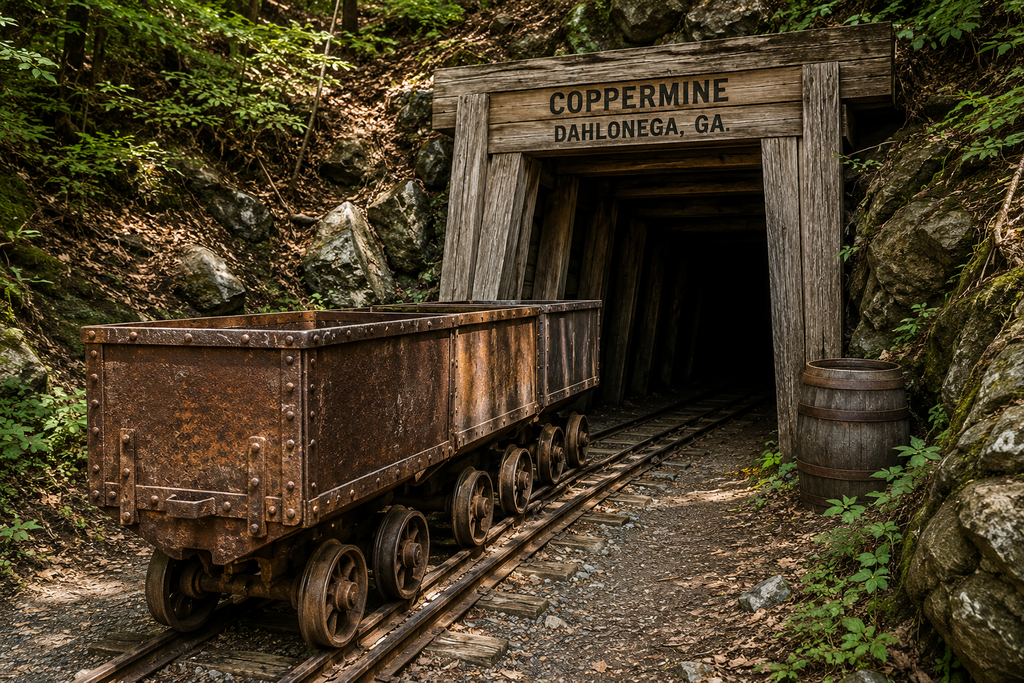
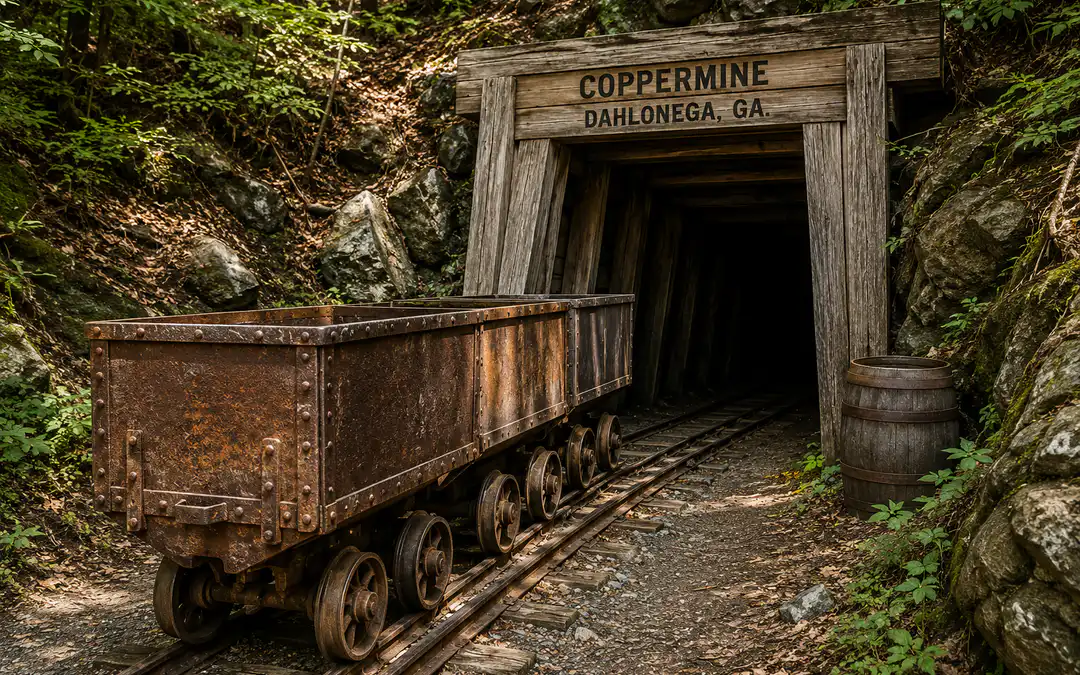
The Copper Mines of Dahlonega, Georgia: A Forgotten Chapter in Gold Country
When people think of Dahlonega, Georgia, one mineral immediately comes to mind: gold. The discovery of gold in the late 1820s brought thousands of miners into the North Georgia mountains and helped establish Dahlonega as one of America’s best-known mining towns. Yet gold was not the only valuable mineral hidden beneath the hills of Lumpkin County. Copper mining also became part of the area’s industrial history, particularly at the Chestatee Mine northeast of Dahlonega.
Gold was not the only valuable mineral hidden in Lumpkin County
From Gold Country to Copper Country
Lumpkin County was established in 1832 during the height of the Georgia Gold Rush. Mining quickly became an important part of the local economy, and prospectors explored hills, creeks, and river valleys throughout the county.
Lumpkin County
Those miners encountered more than gold. Geological records show that chalcopyrite, a copper-bearing mineral, occurred in several of the gold deposits around the Dahlonega district. It was reported at mines including the Lockhart, Singleton, Yahoola, and Battle Branch mines.
Environmental Protection Division
The most important copper operation in Lumpkin County was the Chestatee Mine, which should not be confused with the gold mine that carried the same name. The copper deposit was located on the south side of the Chestatee River, approximately six miles northeast of Dahlonega. Geological studies identify it as a massive sulfide deposit, with chalcopyrite serving as its primary copper mineral.
Copper Mining During World War I
One of the most fascinating periods in the mine's history came during World War I. Historic photographs preserved by the Georgia Archives show the copper mine operating along the Chestatee River around 1917.
The notes accompanying one photograph describe the mine as being “very active during war” and say that the operation was built up during World War I. The site was roughly eight miles east of Dahlonega along what is now the Route 52 area.
This timing was significant. Copper was an important industrial metal, widely used in electrical systems, communications equipment, machinery, ammunition components, and other manufactured goods. As America mobilized its enormous industrial resources for the war, copper became increasingly valuable.
For a community whose mining identity had been built primarily around gold, the copper operation represented another opportunity to put Dahlonega's mineral resources—and its experienced mining workforce—to use.
A Mining Community Along the Chestatee
The mine was more than simply a hole in the ground. Historical photographs reveal buildings and infrastructure associated with the operation, as well as cottages constructed for mine workers and their families.
Digital Library of Georgia
That detail provides an interesting glimpse into what mining meant to rural Lumpkin County. A working mine required miners, supervisors, laborers, transportation, supplies, equipment, timber, food, and housing. An active operation could therefore influence the lives of people far beyond those who actually went underground.
Mining was also difficult and dangerous work. Ore had to be removed from solid rock, brought to the surface, processed, and transported. Early 20th-century miners worked without the sophisticated machinery, ventilation systems, communications equipment, and modern safety technology available to today's mining industry.
The Chestatee River itself had already played an important role in Dahlonega's mining history. Decades earlier, miners had devised unusual methods of recovering gold from its riverbed, including an ambitious 1870s operation involving a steam-powered boat and a diving bell. The later copper operation continued the long relationship between mining and the Chestatee.
What Remains of Dahlonega's Copper-Mining Story?
Copper never replaced gold as the mineral most closely associated with Dahlonega. Gold had transformed the region, influenced the creation of Lumpkin County, and even led to the establishment of a United States Branch Mint in Dahlonega. Copper mining remained a much smaller chapter.
But smaller does not mean unimportant.
The surviving photographs of the Chestatee copper mine provide remarkable evidence of an industrial operation that once employed workers and supported a small community along the river. They remind us that Dahlonega's mining heritage did not end with the first prospectors carrying gold pans into the creeks.
Today, Dahlonega celebrates its gold-mining past through museums, historic sites, mine tours, festivals, and stories handed down through generations. The copper mines deserve a place in that history as well.
They tell the story of a community that repeatedly adapted to the resources beneath its feet—from the excitement of the Georgia Gold Rush to the industrial demands of the early 20th century and World War I.
Dahlonega will always be Georgia's famous gold town, but hidden within that golden history is another story—one written in copper, hard work, and the rugged hills along the Chestatee River.
*** Don't forget you can always find Creative Printing & Signs on social media as well. Here are our pages: Facebook, Instagram, Pinterest, and LinkedIn. More Social Media accounts to come. We will be adding X, Reddit and TikTok