The printing industry has experienced enormous technological changes over the past several decades
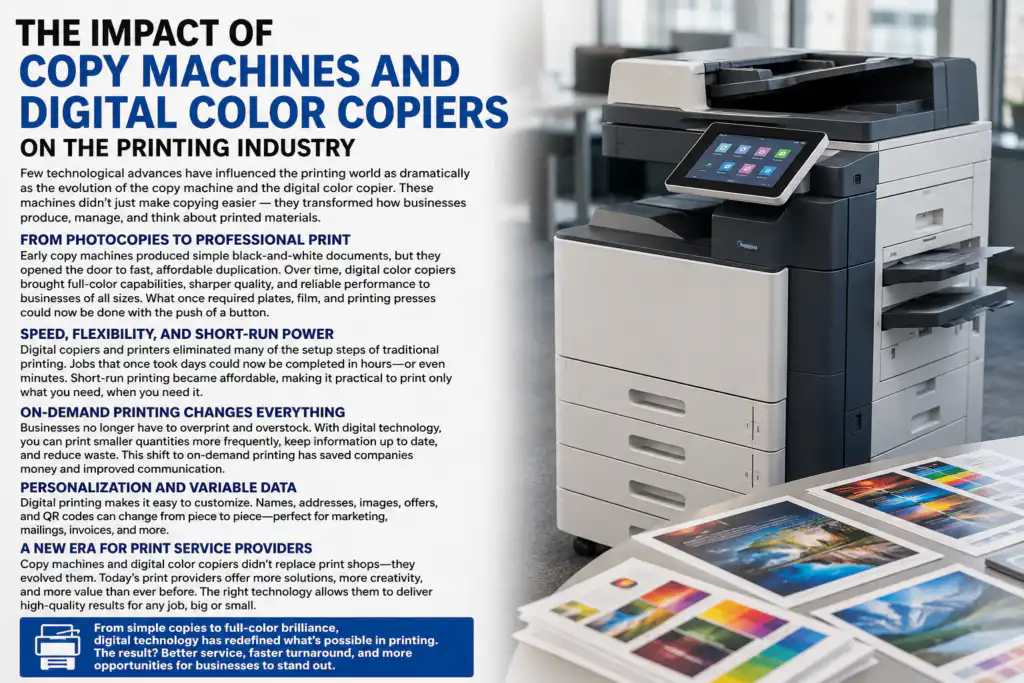
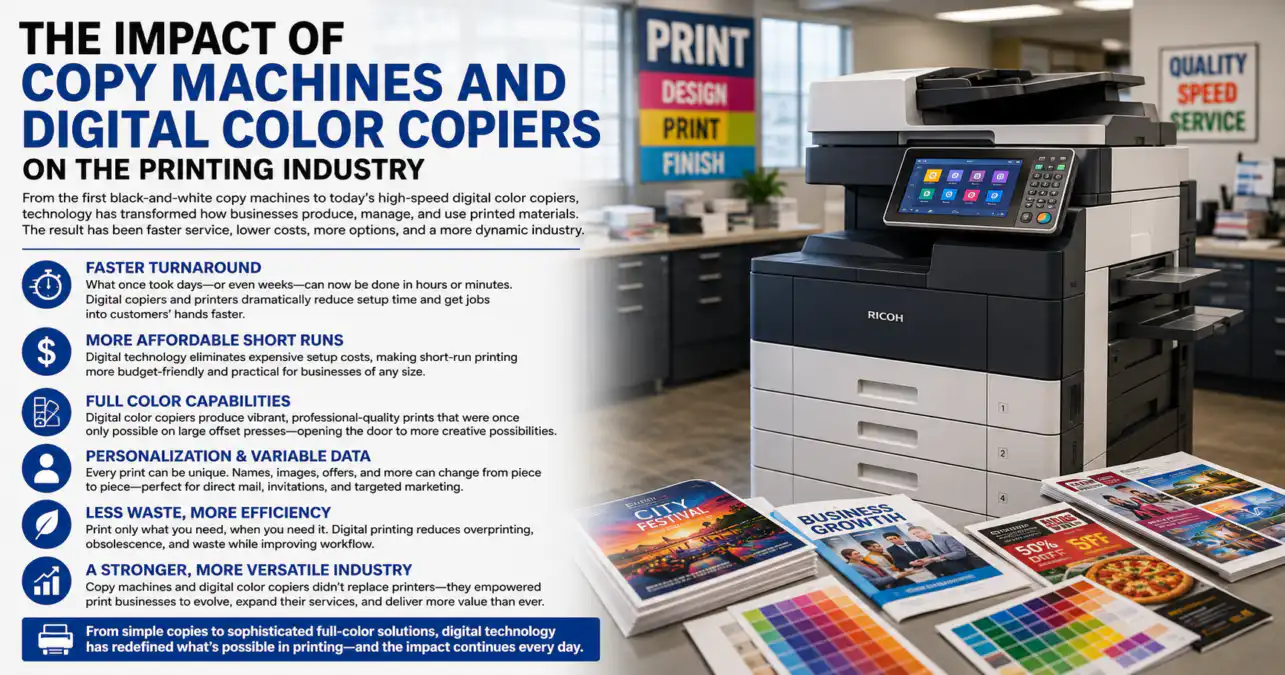
The printing industry has experienced enormous technological changes over the past several decades. Few developments have had as much impact on everyday commercial printing as the introduction of the modern copy machines and, later, the digital color copier. These machines changed not only how printed materials were produced, but also how quickly customers expected their jobs to be completed.
Before digital copying became common, commercial printing was largely a production-oriented business. Producing even a relatively simple brochure, flyer, form, or booklet could involve several separate steps. Artwork had to be prepared, photographs and text assembled, plates created, presses set up, ink adjusted, and sheets printed before the job could move to cutting, folding, binding, or other finishing operations.
For larger quantities, traditional offset printing was—and remains—extremely efficient. But for customers who needed only 50, 100, or 500 copies, all that preparation could make a small printing job relatively expensive.
The copy machine began changing that equation.
The Rise of the Copy Shop
Photocopying technology made it possible to reproduce documents without creating traditional printing plates. Instead of setting up a printing press, an operator could place an original on the glass, select the number of copies, and begin producing finished sheets almost immediately.
As copy machines improved, copy shops became common throughout the United States. Businesses, schools, churches, organizations, and individuals suddenly had an affordable way to produce small quantities of documents.
This helped create an entirely new segment of the printing industry: quick printing.
Customers no longer necessarily had to visit a traditional commercial printer and wait several days for a relatively simple project. They could walk into a copy center with an original and sometimes leave with their copies the same day.
At first, however, copying had significant limitations. Most machines produced only black-and-white copies, and the quality was noticeably different from professionally printed offset material.
That would eventually change.
Digital Color on Copy Machines Changes Everything in Printing Industry
The introduction and improvement of digital color copiers represented another major turning point.
Early color copiers were expensive, relatively slow, and sometimes inconsistent. Over time, however, manufacturers dramatically improved their resolution, color reproduction, paper handling, speed, and reliability.
Eventually, digital color machines became capable of producing output that many customers considered comparable to traditional printing for everyday applications.
A customer could bring in a file containing photographs, graphics, logos, and text and have professional-looking color copies produced within minutes.
Flyers, postcards, business cards, brochures, menus, invitations, newsletters, manuals, presentations, and many other products became practical to produce in short quantities.
This dramatically reduced one of the biggest barriers in traditional printing: setup cost.
With an offset press, printing 100 pieces could require many of the same setup procedures as printing 10,000. With digital printing, producing the first sheet requires relatively little physical setup compared with preparing a traditional press.
That made short-run printing much more affordable.
From Copy Machines to Digital Printing Presses
Modern digital color copiers have evolved far beyond the machines originally associated with office copying.
Production digital systems can print on heavier stocks, coated papers, labels, envelopes, specialty media, and a wide range of sheet sizes. Many systems can automatically duplex sheets, collate sets, staple documents, create booklets, and perform other finishing operations.
As a result, the line between a copier and a digital printing press has become increasingly blurred.
Modern print shops may use production digital equipment for jobs that would have routinely been placed on an offset press decades ago.
Offset printing certainly did not disappear. It continues to have major advantages, particularly for long production runs and jobs requiring certain specialty inks, papers, coatings, or exact color requirements.
Instead, digital printing changed the point at which one production method becomes more economical than another.
A printer can now decide whether a particular job makes more sense digitally or traditionally based on quantity, turnaround time, paper, finishing requirements, and customer expectations.
Printing Becomes an On-Demand Business
Perhaps one of the most important changes created by digital printing was the rise of print-on-demand.
Businesses once commonly ordered thousands of brochures, forms, manuals, or other printed pieces because producing larger quantities reduced the cost per piece.
The problem was that information could change.
A business might order 10,000 brochures only to change its phone number, address, prices, products, or services several months later. Thousands of printed brochures could suddenly become obsolete.
Digital printing offered another approach.
Instead of ordering 10,000 pieces, a customer might order 500 today and another 500 when needed. The artwork could be updated between orders without throwing away thousands of outdated pieces.
This changed the economics of inventory and helped customers purchase printing based more closely on what they actually needed.
Customers Began Expecting Faster Turnaround
Digital copiers also changed customer expectations.
When commercial printing required extensive prepress work and press setup, customers were accustomed to waiting days—or sometimes longer—for their printing.
Digital equipment dramatically shortened that production cycle.
Files could be submitted electronically, processed through a digital workflow, and sent directly to a production machine.
A project that once required several days could potentially be completed in hours.
The phrase "while you wait" became associated with the quick-print industry, and same-day printing eventually became an expectation for many common products.
This created both an opportunity and a challenge for printing companies.
Printers could complete more short-run jobs quickly, but customers increasingly expected faster service.
Desktop Publishing Completes the Revolution
The impact of digital copiers became even greater when combined with another major technological development: the personal computer.
Desktop publishing software allowed businesses and individuals to create professional-looking documents themselves. Instead of delivering physical artwork to a printer, customers increasingly began delivering digital files.
The workflow gradually changed from:
Original artwork → prepress → plates → printing press
to:
Digital file → digital printer → finished product
This removed several production stages and dramatically shortened the distance between design and finished print.
Today, customers can create artwork on a computer hundreds of miles away, email or upload the file to a print shop, and have finished pieces produced almost immediately.
Variable Data Creates New Possibilities
Digital printing introduced another capability that traditional printing could not easily duplicate: variable-data printing.
Because every sheet is generated digitally, information can change from one printed piece to the next.
A mailing campaign, for example, can contain a different customer name and address on every piece. More sophisticated applications can change photographs, messages, offers, QR codes, numbering, or other information according to the recipient.
Instead of producing 1,000 identical pieces, a digital press can potentially produce 1,000 individually customized pieces.
That transformed printing from simply reproducing information into a more personalized communication tool.
The Traditional Print Shop Had to Adapt
The arrival of digital color printing also created tremendous pressure on traditional printing companies.
Companies that relied exclusively on offset presses faced increasing competition from quick printers, office-supply stores, copy centers, and eventually online printing companies.
Successful printers began investing in digital equipment and combining multiple production technologies under one roof.
The modern printing business often bears little resemblance to the print shop of several decades ago.
A single company may now operate digital color presses, wide-format printers, cutters, laminators, binding equipment, direct-to-film equipment, and traditional presses while also providing graphic design and sign production.
The printer has increasingly become a complete visual-communications provider rather than simply someone operating a printing press.
Offset printing continues to be highly effective for longer runs.
What Digital Printing Did Not Replace
Despite predictions that digital technology would eliminate traditional printing, that never completely happened.
Offset printing continues to be highly effective for longer runs. Screen printing remains important for many specialty applications. Wide-format printing dominates signs, banners, vehicle graphics, and displays. Other processes continue to serve specialized markets.
Digital printing instead became another powerful production method.
Its greatest strengths are speed, flexibility, short-run economics, personalization, and minimal setup.
Traditional processes continue to excel where volume, specialty materials, exact color requirements, or particular finishing techniques make them the better choice.
Modern printing companies can therefore select the technology that best fits each job rather than attempting to produce every project using the same process.
A Revolution That Continues Today
The impact of copy machines and digital color copiers on the printing industry is difficult to overstate.
The original photocopier changed people's expectations about how quickly documents could be reproduced. Digital color machines expanded that convenience into professional full-color printing. Production digital presses then transformed the concept into an important commercial printing technology.
Along the way, they helped make short-run printing economical, reduced waste, enabled print-on-demand production, introduced practical variable-data printing, and dramatically shortened turnaround times.
Most importantly, digital technology changed what customers expect from their printer.
Today's customer often wants high-quality printing in smaller quantities, produced quickly and at an affordable price. Meeting those expectations would have been extremely difficult using the production methods available to printers several decades ago.
The copy machine began as a convenient way to duplicate documents. Over time, however, the technology behind it helped reshape an entire industry.
Modern printing is faster, more flexible, and more accessible because of that transformation—and digital printing continues to evolve, ensuring that the revolution started by the humble copy machine is far from finish
*** Don't forget you can always find Creative Printing & Signs on social media as well. Here are our pages: Facebook, Instagram, Pinterest, and LinkedIn. More Social Media accounts to come. We will be adding X, Reddit and TikTok.